Spring and summer are puppy season, when those cute, cuddly balls of fur arrive for the first time in many homes. While we all love puppies, those puppy behaviors - like jumping up and nipping - aren't so adorable coming from a 75 pound dog! That's why Best Friends professional trainers recommend beginning to train your puppy as soon as he arrives in your home.
Learning the basics
Every puppy needs to learn at least the four basic obedience commands: come, sit, stay, and down. Choose a time when your puppy is relaxed, and a quiet area with few distractions. Early training sessions should be short; it's better to spend a few minutes with a puppy several times a day than to try to sustain his interest for a single long period. Start with the "come" command, which is critical for your pet's safety. Best Friends trainers recommend using the leash method. Begin by putting a collar on your puppy. Once he's accustomed to wearing it, attach a leash and standing several feet away, say "come", and gently pull him towards you. As he reaches you, praise him, using a happy tone of voice. Gradually, your puppy will begin to associate the word with the action and you won't need to pull on the leash. Once that happens, practice the command without a leash. Remember to give him lots of praise when he responds by coming to you. Don't try to accomplish too much at once. End each session on a high note, just after your puppy has successfully performed a command. This will make the training process enjoyable and something to which puppy will look forward. As you see your puppy make progress with the first command, you can move onto to "sit" and then "stay". Once puppy has mastered these commands, you can begin to teach him to walk properly on a leash.
Getting started
There are many good books on puppy training, but best way to get your puppy's training started is by joining a group class. Training classes also provide an opportunity to socialize your pet, which is important to his emotional well-being. Dogs that aren't adequately socialized can become shy and fearful. In fact, many behavior problems in older dogs stem from lack of adequate socialization as a puppy. Check your local Best Friends center for class schedules.
Showing posts with label dog training il. Show all posts
Showing posts with label dog training il. Show all posts
Saturday, July 10, 2010


Wednesday, June 2, 2010
One Half of the Oscar Mayer team
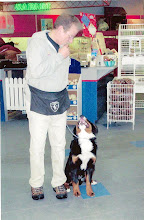
Here I am in the isle of the Best Friends Pet Motel in Prairie View. I have half of the Oscar Mayer duo with me. I have had him for 2 weeks of board & train. He started off shy and would not take food. Well that's not a problem any more. He loves spending time with me. We began in the Canine College which is where the group classes are held. It is a good place to bond and introduce the game of obedience. Once this is accomplished we practice and perfect around the 6 plus acre facility. We have made it to the lobby where we can practice with a higher level of distraction. In this first video we are adjusting and working together in a narrow isle. I do have dogs adjust to me all the time and everywhere especially if in a new area or room. I never walk into a room following a dog.
Now here we are in an even tighter area next to some racks for food. Again watch Mayer adjust as I turn to the right or the left.
The only thing that could be more fun would be to do this with 2 Dachshunds , my buddy Oscar and his partner Mayer. Maybe the next visit to the Best Friends Pet Motel I'll be able to work both. Allan
Now here we are in an even tighter area next to some racks for food. Again watch Mayer adjust as I turn to the right or the left.
The only thing that could be more fun would be to do this with 2 Dachshunds , my buddy Oscar and his partner Mayer. Maybe the next visit to the Best Friends Pet Motel I'll be able to work both. Allan
Tuesday, May 25, 2010
Rudy S. French Bulldog Loves Obedience
Rudy is a French Bulldog that started in my group obedience handled at first by his dad, Mark and now his mom, Linda. He really loves to please the leader. I was lucky enough to have him over the weekend. The busier I keep him the more he likes it. He works for food but is easily stimulated by vocal praise as we work. I practice an obedience pattern but any time I want him closer I shift into a higher or more challenging gear. I do what in Rally Obedience is called a left about turn, German about turn or a Schutzhund about turn, followed by a quick and tight left 180 or 360. This group of moves really helps to define the pocket or the position to easily turn right or left with the handler.
Monday, May 17, 2010
Pflash & Tito, Over & Under, Sometimes you just have fun with your dogs.
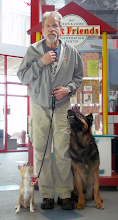
I wanted both of my dogs to go over the jump at the same time. It wouldn't be fair to a Chihuahua and a German Shepherd jump the same height. I set up the jump and had Tito jump a lower bar while flash jumped a higher bar. Tito likes to let Pflash jump first so he doesn't have to worry about things over his head landing on him.
Thursday, April 29, 2010
Group Obedience Class- Demonstrates a left & right finish after call to front
On the first recall I ask them to finish on the left and the second time I have them finish on the right. The left is called a swing and the right the dog goes around on the handler's right then goes behind and ends up in the heel position with the dog on the left.
Now we have the Saturday class in the lobby demonstrating the same moves but with more distractions. We have Nancy & Louie, Ann & Lava and Sue & Onslow. We have Rally Obedience Classes here on Saturday morning at 11a.m. It is a requirement for Level 1 that the dog be able to finish on the left or the right. Level 1 is on leash and Level 2 & 3 are done off leash with the signs that you follow being more difficult. Rally is a fun way to practice and compete in several organizations like AKC with or without a pedigree, UKC, or APDT. Rally is something for those who look for a higher level of obedience. It can be done for fun or for those who desire they can title dogs pedigree on not. All you need is a dog that likes to work with you plus you will have a level of control that you can use to show off if you desire. It just looks good to see a dog working obediently with their handler. If you are interested give me a call and I'll invite you to come and watch a practice session. Allan
Saturday, March 13, 2010
How To Choose The Right Pet
Considering a New Addition?
How to Choose the Right Pet for your Family
If you are thinking about opening your hearts and homes to a new family member, it's important to choose the right pet for your family and lifestyle. Remember, the decision to get a pet should always be a family decision, not just one made by the kids or mom and dad. After all, everyone is going to play a part in raising and caring for this new family member!
Before choosing your pet, be sure there are no restrictions in your community or housing area. Check pet policies in contracts or leases, and consider size limitations. Also, keep in mind that owning a pet is going to mean an increase in household expenses.
Deciding what type of pet to get involves answering a lot of questions, including:
What age are the children? The ASPCA offers specific guidelines when choosing pets for homes with children. It is generally recommended that children under 10 be introduced to small pets such as guinea pigs, mice or fish. Children over 10 can help with the responsibilities of caring for a dog, cat or rabbit, and even participate in training classes. As the children enter their mid to late teens, however, keep in mind that they'll be preoccupied with their own lives, and won't be willing to devote as much time to Fluffy.
Does anyone suffer from allergies? If so, your choices may be limited. Check with a doctor and/or veterinarian.
How much time is spent at home? Puppies and kittens need a lot of human attention, especially for house training and socialization, and learning what not to do. Even older pets need time to learn what will be expected of them .
How involved will the pet be in family activities? If your family tends to lead an active lifestyle, you'll want to consider getting a hardy dog who enjoys the outdoors. These pets must be well-behaved, too, which involves a commitment to ongoing obedience training.
Are there other pets in the home? Resident pets generally enjoy the company of another pet, provided they're compatible and introduced in appropriate manners. Bringing a kitten into a household of 3 dogs may not be the best idea, but that kitten may enjoy being the friend of an older feline.
Monday, March 8, 2010
House Training Your Dog
When Accidents Happen: Re-Housetraining Your Pet
Even the best-trained pet can have a temporary housetraining lapse. Cold weather and changes in a pet's schedule, food or environment can also result in an occasional "accident."
But when accidents continue to pile or puddle up on your floor, intervention is in order.
Before you can correct the problem, you need to identify its source. Some possibilities include:
Medical reasons -- Because your pet wants to please you and won't intentionally disobey, a physical cause (such as an infection or illness) should be considered before anything else. See your veterinarian if housetraining errors persist.
Change in the environment - If something - or someone - new has been added to the household, your pet may feel threatened. Be sure to include your pet in the introductions and devote some extra attention and playtime.
Scents and odors from other pets can stimulate your pet to mark his territory as well. Be sure to clean any soiled areas thoroughly, using a solution that remove odors (these products are available at your local Best Friends center ).
Fears or phobias - Animals can lose bladder or bowel control when they're frightened by a loud noise or sudden sound. Your pet may also soil the house as a result of separation anxiety. Be sure to discuss these symptoms with your vet and/or professional trainer.
What NOT to do
Never punish your dog if she's had an accident in the house! Unless she's actually caught in the act, your pet will have no idea what she's done to upset you. Punishment after the fact will add to your pet's stress, or may make your pet afraid to eliminate in your presence.
Even if you catch her in the act, don't hit or hurt her. Instead make a loud noise to interrupt your pet, and then quickly take her outside to her toileting area.
Don't blame your pet if the accident is a result of your bad timing. Learn your dog's signals and stick with established routines. Don't expect your pet to be able to "hold it" longer than she's physically capable.
Getting back on track
Once the basic problem is identified, the best way to re-establish housetraining is with a consistent routine because dogs are creatures of habit.
Feed your dog at the same time every day, and take him out at the same times to the same elimination area. Praise your dog when he eliminates outside.
Until housetraining is re-established, it's important to supervise your pet as much as possible. Don't give him the opportunity to eliminate in the house, because an accident can set back the re-training. This may mean you need to temporarily crate or confine your pet during this period. If so, make sure he is comfortable and has something to play with or chew on. Be sure to take him out to eliminate as soon as you return home.
Newly adopted dogs
Many adult dogs adopted from rescue shelters have been previously housetrained. However, due to circumstances at the shelter, their housetraining may have lapsed. If this is the case with your pet, start the housetraining process from the beginning.
Be consistent, and above all, patient, and your pet should be back to his outdoor business in no time.
Thursday, March 4, 2010
When Your Dog Won't Go Out In The Cold
It's dark, cold and snowing or raining... and it's time for your pet to go out to eliminate. The last place you want to be is outside walking your dog, but the only one who'd rather be inside more than you is your furry pal.
What do you do?
"It's not uncommon for pets to resist going out in freezing or inclement weather," says Nadja Torling, professional trainer at Best Friends "However, when nature calls, neither of you has much choice."
Some pets are simply averse to going outside in certain conditions, says Torling. For example, some small breeds such as Italian greyhounds dislike cold surfaces. However, with a little time, practice and patience, you can train your pet to go out, "do his business," and get back indoors quickly.
Get up and out
Best Friends professional trainers advise taking the following steps to coaxing your pet into going outside:
Exercise first -- Dogs often need to eliminate after a stimulating play session, and will be more cooperative about going outside when they're alert and attentive. Playtime can include mental exercise - like dog puzzles -- as well as physical activity.
Dress for success -- invest in cold weather clothing and gear for your pet, especially smaller breeds. A fleece sweater, raincoat and booties protect and provide extra warmth.
One step at a time -- start off slowly, and use plenty of positive reinforcement. Encourage your pet to stay out for just a bit, and then ease him into longer periods.
Incorporate rewards - every time it rains or snows, bring your pet outside and reward him with a high-value treat so he learns that being outside can be a positive experience.
When your dog makes mistakes
Sometimes a particularly stubborn pet will just refuse to go out. They may even have "accidents" in the house. This is not something you should tolerate; each time your dog is allowed to eliminate in the house, she learns that it's okay to do so.
In those cases, Torling advises, you must approach the situation as if it were the initial potty training stages: bring her to a sheltered spot, use your potty training words and wait. If she still doesn't go, bring her back in and try again in ten minutes.
If necessary, confine your dog - as you did when she was a puppy - to her crate or a small pen between these outdoor trips. Don't let her out of your sight until she takes care of business outdoors.
If your pet does eliminate in the house, it's critical to clean up thoroughly with an enzyme product that eliminates the odor. You may also want to block off the area so your dog cannot return to that area.
"You may never get an indoor-oriented pet to love going outside," says Torling, "but you can certainly get them used to it."
Friday, February 5, 2010
Oliver K. & Bear A.• Watching kittens watching them
While I work on perfecting the obedience that I've taught to dogs in board and train I take advantage of distractions at Best Friends Pet Motel. In our lobby we have a retail area, hotel check in, grooming, bird boarding and cats in 2 areas. Young at Heart Pet Rescue has a shelter and the other area with Young kittens. I have the dogs I'm working either sit or down while they can see the cats. The Young kittens are equally fascinated by the dogs. I began to film this and find it quite relaxing. I think this is like watching a fireplace on television. What do you think?
The above video is Oliver a 4 month Yorkie doing board & train during day care and returning home each night after mom is finished with work.
The second video is Bear A. a 9 month German Shepherd puppy in his second week of board & train. This week is spent perfecting the skills we learned except in areas of higher distractions. Bear definitely found the cats most amusing and entertaining. They found him entertaining as I did with all of them. Enjoy.
Thursday, January 28, 2010
Bear A • German Shepherd pup at 9 months in Board & Train
Bear is a young male German Shepherd pup at nine months old in board and train. It took a while to get him to realize he's following me. He is an example of a dog that if you give him an inch he'll take a mile. Way too excited at pick up before I get the collar on. I can tell by the way he looks at counters and garbage cans as though they might provide something of interest to him that he has been there before. In stimulating areas he watches and tries to give a sniff to people passing by. He wants to bark at dogs he sees. He would like to join Evelyn for her lunch by getting around her to her food. He is smart and has learned if nobody is watching for a few seconds he can steal anything.
This is a working dog with lots of ball drive and food drive. He can do very nice obedience in areas of lower distractions. After spending time in the quieter Canine College we began to work on perfecting which is showing him that obedience is everywhere. Food preparation is full of activity including a washer, dryer and compressors along with tables of food and dogs going so me activity we provide at Best Friends American Pet Motel. We walked in the courtyard by barking dogs from Tails of Hope rescue.
The lobby was the most fun. Bear watched cats playing in the Young at Heart cat shelter in the lobby. He eventually did a long down with me 8 feet away watching hyper barking dogs check into the hotel and grooming. Bear has come a long way but it will take the continued practice guiding him in stimulating areas and showing him the way you want him to behave. Please continue in pet stores, parks, group classes and any other training you have in store for him. He's been bred to do whatever you want.
Sunday, January 17, 2010
Make Your Own Dog Treats
The best way to train your dog is through positive reinforcement, and of course a few yummy treats along the way! If you do not have time to come to our pet store located here inside Best Friends Pet Care you can make your own treats at home! Just remember with dog training a little treat goes a long way. Make sure to break the treats up so you can reward your dog every time with a little something.
PEAMUTT BUTTER BISCUITS
1/4 cup peanut butter
1 tablespoon vegetable oil
1 cup water
2 1/4 cups whole wheat flour
1 cup oatmeal
Preheat oven to 375 degrees. In a large bowl combine peanut butter, oil, and water. Gradually add flour, then oatmeal. Roll dough to 1/4 inch thickness and cut with a cookie cutter. Place on an ungreased cookie sheet. Bake at 375 degrees for 35 minutes. Makes 2 1/2 dozen.
Dog treat recipe from The Original Doggy Bone Cook Book By: Michelle Bledsoe
Saturday, January 9, 2010
Winter Dog Tricks

As a dog trainer I would normally not reccomend this style of play. However this is just too funny! Click on the above photo to view Bailey and his tricks!
Sunday, January 3, 2010
Beckham • Miniture Schnauzer 7 months
Beckham is a delightful 7 month miniature Schnauzer. I had him for a week of board and train. At first he had issues with socialization and quite a few areas he was afraid to walk. We started by bonding while working on foundation obedience. Luckily he has great food drive which helped to distract him in worrisome situations. When dogs look at me and take food I find they are in a calm state and can absorb stimulation without wanting to avoid or go to flight. Initially he had issues with heaters, shadows, fans, almost anything new. The more we worked the more easily he was able to keep moving. By practicing the things that were new became old and I watched him go from being shy to quite the opposite. It is easier to calm him down now that he is moving forward. Some people think when their dog does not come that they are being disobedient but if you look at the bigger picture you might be standing next to something they are afraid to be near. I've seen where dogs will not come in after going potty if the dominant dog is inside first. Or the opposite when a dog will not potty outside because the dominant dog owns the yard. I do not see being submissive or shy as happy and it is our job to help a dog get over issues allowing for a happy and less fearful life. I think there are more bites by shy dogs that feel cornered than by aggressive dogs. By helping to socialize we can keep problems from occurring. I'm happy to say Beckham's owner plans to continue in the group classes.
Monday, December 28, 2009
Louie D.• Meet & Greet
Louie is a lab rescue that has been with the family about 2 weeks. Board and train is an excellent way to introduce a new dog to you and your life. He is about 14 months old. He has strong food and ball drive. He loved foundation obedience. We bonded in a quiet area then perfected on our 6 plus acre facility. This is an exercise called Meet & Greet. The object is to teach the dog that he must sit for attention and affection. Once sitting I use the "off" command to keep him from touching with his paws or mouth. He then gets his chest rubbed and even a cookie. We use foundation obedience exercises to guide him to be the best the handler wants him to be. I would love to see Louie and his family in my intermediate group class.
Checkers• It's never too late• A Dalmatian @ 6yrs
Checkers is a 6 year old female Dalmatian. Mom and dad came to visit an intermediate/advanced obedience class. They were quite impressed with what could be expected from a trained dog. I had her for a one week board and train. At first we bonded practicing foundation obedience in a quieter area without distractions. Then we worked in more stimulating areas. She had aggression issues with other dogs. Once I get to know her it is easy to recognize when she is about to need some help. By observing her body language I can make adjustments before negative behavior becomes pronounced. I believe I can correct the thought which is before she initiates a negative reaction. We practiced in a lobby full of dogs and I was able to head off any potential issues before she misbehaved. Once I know with proper guidance Checkers can behave her parents just need to practice to let her know that is also their desire.
Tuesday, December 22, 2009
PetTube.com....Now accepting training videos
Did your dog become a superstar in one of Best Friends training classes? Has he really learned some cool tricks on a private lesson? Show off his talents in his very own video on the Internet. (For those of you who have worked in Board and Train or private lessons, I might have already uploaded your work on the blog) PetTube.com, check it out today. Remember every dog is a superstar with positive training! I'll be watching!
Thursday, December 17, 2009
Wally D.•Energetic Cockapoo @ 6 months
Wally is a blast. Full of energy. Just needs direction. A coupla private lessons followed by basic class, Wally ended up with me in board and train. He's still full of energy as with most 6 month old pups except he has the concept of working and following a human. He is still easy to stimulate and loves people but now he has learned how to make the leader happy and loves to make that happen. Positive reinforcement and good timing has made obedience a way to have fun with his human partner. He's having a blast. As a trainer I want him to work the most enthusiastically without going over the edge. Its a balancing act, my voice, my body language the noises I make all keep him interested and working with me. The owners plan to continue daily practice combined with intermediate group classes so that they can guide Wally to be the best they want him to be. See you in class!
Onslow CGC RL1•Pivot L&R/Pivot L&R 1 Step
RALLY CLASSES HAVE BEGUN AT BEST FRIENDS Saturdays at 11a.m.
Onslow R. is just a delight to spend time with. When his mom is out of town she prefers board and train. Mom has worked him regularly in group class and they have improved so much they have begun to compete in APDT rally. Rally classes have begun on Saturdays at 11 a.m.
Monday, December 14, 2009
Onslow CGC RL1•Pivot Left 360
CONGRATULATIONS to Onslow CGC,RL1{Canine Good Citizen/Rally Level 1}. He works with me around our 6 plus acre facility off leash. His mom says board and train is the only way to go. She works with him in my group obedience classes and in rally obedience class. He just completed his three legs, in an APDT trial on Nov. 21&22 in Schiller Park. They passed 4 trials in two days. In one trial they scored 204 out of 210 possible points. Not bad for her first trial and being a novice handler who never imagined this could be something she would do let alone compete at.
Onslow•Left 180 & Left About Turn
Onslow is a delightful Goldendoodle I've had the pleasure to work with. Here we are in the lobby where we are practicing obedience off of the leash. We do a tight u-turn to the left and a left about turn which is where I turn into the dog and he goes the opposite way. Onslow has begun to compete at rally obedience. He passed his first four APDT rally obedience events. Congratulations to him and his owner who never thought she would be proudly competing in dog trials.
Subscribe to:
Posts (Atom)

Pflash