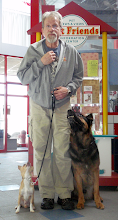
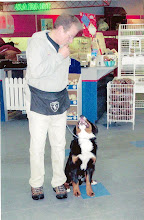
One dog sits or downs in the center while the rest of the class circles. When they stop they get close as possible to each other. They are socializing and getting used to being in close quarters.
The handlers get to be prepared for the way their dog might act and have a plan. The handlers learn to see the signs another dog may not be acting right and do what is best for their dog. Barb and Phoenix, Gina and Logan, Ed and Maggie, Lauren and Louie, Sue and Onslow, Cathi and Lefty
Showing posts with label dog training tips. Show all posts
Showing posts with label dog training tips. Show all posts
Saturday, October 30, 2010


Tuesday, October 26, 2010
Demi B. A Great Dane Puppy
It is so much fun to pick up Demi and spend some time with this energetic Great Dane puppy. She just turned 5 months. She is in her first week of Board and Train. We began in the Canine College learning some foundation obedience. I am using my voice, touch, food and a Kong on the rope to keep her loving the game of obedience. Today was her third day and after some practice we took advantage of all the distractions available at a full service hotel.
Here we are out in the courtyard. At first she was distracted by the rain coming out of a gutter and dripping into a puddle but after sitting next to the distraction she relaxed and was enjoying taking treats from me for sitting as I asked.
Now were sitting in front of the industrial washer in food preparation. This area has a lot going on from dogs arriving and leaving, food on tables and dogs on walks. At first Demi was bothered by the fleece going back and forth but once again after sitting and observing I was more fun than the distraction and the washer became another thing on the list of things she got used to. Every new thing becomes easier than the last all helping to make Demi more stable.
Before we go into the lobby and practice Meet and Greet and work around dogs checking into the hotel we spend some time sitting closer and closer to barking dogs. The more layers of days like this working through distractions the more stable and calm she will become. Clients always say their dogs come home calmer after spending time with me. I'm willing to take the time to help them through difficult situations.
Thursday, October 7, 2010
More George
I was so happy to have George back a Boston Terrier in for a visit. I always get some intense pictures of him as I control the games with food. He has strong food drive which helps to get him through difficulty. In the previous post he is looking at a dog in my office. This may be easy for some dogs but can be problematic with George. I like to redirect which tends to lessen the degree of distraction. Want to sit close and be getting treats and playing food games while getting petted or shall we walk away, calm you down and work back here before you get more praise.
While Jen shot the video for me she said, "it looks like a magic trick." I call it the reappearing food. It looks cool. One time, "off" for all of the food and then he must wait for, "take it" before he can take each additional piece that pops up from my hand. Now Here we are using this trick while a cat watches with envy.
Thanks Bryan and Anna and I hope to see you in class. Tuesday night at 7pm or Saturday morning at 10am. Rally could be fun. There is one dog on the course at a time. The Rally Class is Saturday at 11am. There is a Halloween Party here at Best Friends on October 30 from 10am until 4pm. There will be a Level 1 Rally Obedience Course and a ZOOM Course to try at 12-1pm.
Watch Jazzy ZOOM on my post Oct 2 or see some Rally Demo and Sign sample exercises on June 18th post performed by some Rally dogs.
Wednesday, October 6, 2010
Poblem Solving
Buddy R. is a Yorkie who has spent some time with me in Board and Train, had some private lessons with his mom, and even come to some group classes. He has played with my dog Pflash. He is like a friend of the family. When he comes to the Dog Park he has some issues with the mowing. Well his mom was out of town a few days and requested that I spend some time on Tuesday working when the landscapers are here helping to resolve this problem. So of course here we are out in the field watching the mower go by.
Then of course we watch the guy with the trimmer and then finish with some more calmer work watching the mower go by again.
Now here comes George H. a Boston Terrier with some aggressive problems when around other dogs. I try to set up controllable situations so I can guide the dog through what otherwise would be difficult. Here we are outside of my office and there are some visitors. The more we can have positive experiences rather than the usual outbursts we begin to change the norm. Time, patience and calm repetitions is key.
Friday, September 17, 2010
Winston and Bentley...a coupla Westies
Winston and Bently are two brother Westies. They are 11 months old. I have worked with them at about 5 months and now have them for a week in Board and Train. We brushed up on our basics. Long sits at all doors and gates that are closed and then open and we do not proceed until they make eye contact or acknowledge the leader. Easy exercise and your patience will be rewarded. Now the fun starts. I want to work the two together. I've had 2 German Shepherds, 2 Great Danes, 2 Labs, 2 Daschunds, 2 Wheatons, 2 Lhaso Apso and lots of unmatched pairs. I usually keep one on the left and one on the right. This way if one is correct he is not as influenced by his partner and if you make a tug it will be for the one that needs it.
We were out on our 6 acre facility practicing with distractions after working together in the Canine College. As we left the parking lot and down Pet Lane towards Aptkisic Road we passed the landscaping facility across the street and both dogs were bothered by a tractor.
Now we had to stop and watch for a while. I like to have them sit or down and absorbe while praised and kept in a calm state of mind. When we came back they paid no attention to the boreing tractor noise.
Well we hung out watching traffic go by as they learn with me and off to the side we are safe. It is important to be aware and not afraid of noise and distractions. Practice makes what is new old.
Now we just hang out in the lobby and watch the campers and the guest come in to the motel. I had fun working with this energetic duo and hope to see them in group class on Tuesday night at 7pm or Saturday morning at 10am.
Saturday, August 28, 2010
Welcome back Bailey ...Talk about getting lucky!
I've had the pleasure to work with Bailey, a Shetland Sheepdog in Board and Train and her mom used to bring her to group obedience class. She loves to have a job to do so she can relax and just go for the ride. She has had an issue with barking so first we watch some dogs playing in an outdoor camp area.
Bailey S. in the courtyard watching Vlad and Woody bark at her. Baily was happy to be with me and did not react negatively towards the dogs that were barking at her. That's my girl!
Talk About Getting Lucky!!!!!!!!!!!!!
Mom dropped her off for a couple of days and asked me to spend some time working around cars. She gets stimulated and is difficult. Well Dianne, I don't think you would enjoy this coincidence as much as I did. We get to Aptkisic as I hear an ambulance and fire truck coming towards us from Weiland Rd. I had to get my camera out and bam here is the video. Good Girl Bailey! Hope to see you back in class.
Saturday, July 10, 2010
New Puppy? Don't Wait To Start Training
Spring and summer are puppy season, when those cute, cuddly balls of fur arrive for the first time in many homes. While we all love puppies, those puppy behaviors - like jumping up and nipping - aren't so adorable coming from a 75 pound dog! That's why Best Friends professional trainers recommend beginning to train your puppy as soon as he arrives in your home.
Learning the basics
Every puppy needs to learn at least the four basic obedience commands: come, sit, stay, and down. Choose a time when your puppy is relaxed, and a quiet area with few distractions. Early training sessions should be short; it's better to spend a few minutes with a puppy several times a day than to try to sustain his interest for a single long period. Start with the "come" command, which is critical for your pet's safety. Best Friends trainers recommend using the leash method. Begin by putting a collar on your puppy. Once he's accustomed to wearing it, attach a leash and standing several feet away, say "come", and gently pull him towards you. As he reaches you, praise him, using a happy tone of voice. Gradually, your puppy will begin to associate the word with the action and you won't need to pull on the leash. Once that happens, practice the command without a leash. Remember to give him lots of praise when he responds by coming to you. Don't try to accomplish too much at once. End each session on a high note, just after your puppy has successfully performed a command. This will make the training process enjoyable and something to which puppy will look forward. As you see your puppy make progress with the first command, you can move onto to "sit" and then "stay". Once puppy has mastered these commands, you can begin to teach him to walk properly on a leash.
Getting started
There are many good books on puppy training, but best way to get your puppy's training started is by joining a group class. Training classes also provide an opportunity to socialize your pet, which is important to his emotional well-being. Dogs that aren't adequately socialized can become shy and fearful. In fact, many behavior problems in older dogs stem from lack of adequate socialization as a puppy. Check your local Best Friends center for class schedules.
Friday, June 4, 2010
Meet & Greet with Nicholas S.
I am familiar with the skills of the dogs and the handlers so when I have a visitor like Nicholas S. that comes with his parents to class I encourage meet and greet exercises. There are 3 very important things occuring here.
1) The handler is learning to control their dog and the guest.
2) The dog is learning the way the leader desires them to act.
3) The child or guest will learn to approach and not stimulate the dog with their behavior.
The more everone practices the better they all get.
1) The handler is learning to control their dog and the guest.
2) The dog is learning the way the leader desires them to act.
3) The child or guest will learn to approach and not stimulate the dog with their behavior.
The more everone practices the better they all get.
Tuesday, May 25, 2010
Rudy S. French Bulldog Loves Obedience
Rudy is a French Bulldog that started in my group obedience handled at first by his dad, Mark and now his mom, Linda. He really loves to please the leader. I was lucky enough to have him over the weekend. The busier I keep him the more he likes it. He works for food but is easily stimulated by vocal praise as we work. I practice an obedience pattern but any time I want him closer I shift into a higher or more challenging gear. I do what in Rally Obedience is called a left about turn, German about turn or a Schutzhund about turn, followed by a quick and tight left 180 or 360. This group of moves really helps to define the pocket or the position to easily turn right or left with the handler.
Sunday, April 11, 2010
To Fetch or Not to Fetch? Pflash will be 9 in July

There are training organizations that require your dog to retrieve a wooden dumbell sometimes up to 3 pounds. There are people who have a dog that will retrieve anything except a dumbell. Why do you think that is? Pressure. For the first time the dog has to get something without play value, or so the handler is told or believes. Here comes the age old question and debate, play or force. I've had many discussions over the value of each. Those that force say there is more reliability. There is the Koehler method, e-collar, and, etc. I believe the play method using the natural instinct for prey is more motivational and a dog trained in this manner will usually go quicker and more happily than a dog that is forced. It is possible to force and with practice and positive communication also have a dog that will return quickly and top trainers are flexible and can apply a combination of all techniques. Although too many times with the pressure from a trial or competition when the handler gets stressed or the e-collar is removed the dog will no longer retrieve.
Unfortunately housebreaking issues often come between a handler and a dog that will listen. To often, "come" or "here" means, I'm putting you in the crate, cutting your nails, showing you the molding or chair you chewed or the poop in the living room.... If you have a dog that will not come because they associate coming to you with disclipine they will avoid coming. If you want to play sometimes the dog will not come to you because he fears you will take the toy away and this causes avoidance. This is why fetch should be taught with a dog on a leash. #1) They must come. #2) You can play tug. This builds drive which can ultimately be used to motivate and also if you play tug or, "rock & roll" as I refer to tug, the dog will enjoy the interaction more than having you chase them for the toy. Dogs need to think of the fun they have with you in terms that you define. Once you play tug it is okay to let the dog win the prize and carry it while heeling. While walking or a call to front, I'll grab the toy preferably by the handle. I like a ball or kong or rolled burlap with a handle or rope. I only play if the dog has his end (the wet end).
I currently have a client's dog who only will get one ball and will not release it. In order to teach the fetch I think it would be dangerous to stimulate play/prey drive holding a 3-4 inch diameter ball in my hand. Training involves teaching the dog which end is his in a safe and controlled manner. There are important rules for tug. I believe if you control the games you control the dog. There must be "out" which teaches the dog that even though he has won the prize he must relinquish it to you. This is a controlled game that must be taught by adults. Dogs need to learn they must give, "out" to our kids and with our help carefully make sure the dog does not learn he can take anything from what he considers his siblings or littermates. There are trainers that say tug is dangerous and makes dogs mean. It will make them dominant if they think they can win whenever they want any time they wish.
When we build drive and then control it we then use it to motivate the dog. Carry the ball to get eye contact while heeling, reward for a quick sit by throwing "bring," or call to front and throw the ball for a reward after a close sit. At first we use food to bait, later it can become a reward for doing what we asked but there is nothing more motivational than paying with a toy that is the source of the drive we build.
The goal or target should be kept in mind. Do not hope the dog will get the item then pray he will bring it to you then hopefully he will give it to you. Be patient, go slow, teach and most important do not let your dog see stress or frustration because it will set you back. Trainers must be flexible in their approach and watch for signs of avoidance. Don't keep doing the same things that are not producing what you want
My dog, Pflash will sit next to me and wait as I throw the dumbell or ball on a rope. I say, "bring" and he runs fast to get it and brings it back to me. He sits in front of me and holds it until I ask for it, "out." Then I say, "heel" and he finishes and sits next to me. If I had him do that every time he would not go as fast or have as much fun and that's because he only has to perform once and most of the time its play. I do not encourage too much tug with a dumbell because it can cause chewing but in the dogs mind its important it's just another toy. I also would not teach the retrieve over a jump or scaling wall until the retrieve on the flat is perfected. I will practice the jumps without a retrieve just going over and back. Good Luck and remember the faster the retrieve the better it looks.
Saturday, March 13, 2010
How To Choose The Right Pet
Considering a New Addition?
How to Choose the Right Pet for your Family
If you are thinking about opening your hearts and homes to a new family member, it's important to choose the right pet for your family and lifestyle. Remember, the decision to get a pet should always be a family decision, not just one made by the kids or mom and dad. After all, everyone is going to play a part in raising and caring for this new family member!
Before choosing your pet, be sure there are no restrictions in your community or housing area. Check pet policies in contracts or leases, and consider size limitations. Also, keep in mind that owning a pet is going to mean an increase in household expenses.
Deciding what type of pet to get involves answering a lot of questions, including:
What age are the children? The ASPCA offers specific guidelines when choosing pets for homes with children. It is generally recommended that children under 10 be introduced to small pets such as guinea pigs, mice or fish. Children over 10 can help with the responsibilities of caring for a dog, cat or rabbit, and even participate in training classes. As the children enter their mid to late teens, however, keep in mind that they'll be preoccupied with their own lives, and won't be willing to devote as much time to Fluffy.
Does anyone suffer from allergies? If so, your choices may be limited. Check with a doctor and/or veterinarian.
How much time is spent at home? Puppies and kittens need a lot of human attention, especially for house training and socialization, and learning what not to do. Even older pets need time to learn what will be expected of them .
How involved will the pet be in family activities? If your family tends to lead an active lifestyle, you'll want to consider getting a hardy dog who enjoys the outdoors. These pets must be well-behaved, too, which involves a commitment to ongoing obedience training.
Are there other pets in the home? Resident pets generally enjoy the company of another pet, provided they're compatible and introduced in appropriate manners. Bringing a kitten into a household of 3 dogs may not be the best idea, but that kitten may enjoy being the friend of an older feline.
Monday, March 8, 2010
House Training Your Dog
When Accidents Happen: Re-Housetraining Your Pet
Even the best-trained pet can have a temporary housetraining lapse. Cold weather and changes in a pet's schedule, food or environment can also result in an occasional "accident."
But when accidents continue to pile or puddle up on your floor, intervention is in order.
Before you can correct the problem, you need to identify its source. Some possibilities include:
Medical reasons -- Because your pet wants to please you and won't intentionally disobey, a physical cause (such as an infection or illness) should be considered before anything else. See your veterinarian if housetraining errors persist.
Change in the environment - If something - or someone - new has been added to the household, your pet may feel threatened. Be sure to include your pet in the introductions and devote some extra attention and playtime.
Scents and odors from other pets can stimulate your pet to mark his territory as well. Be sure to clean any soiled areas thoroughly, using a solution that remove odors (these products are available at your local Best Friends center ).
Fears or phobias - Animals can lose bladder or bowel control when they're frightened by a loud noise or sudden sound. Your pet may also soil the house as a result of separation anxiety. Be sure to discuss these symptoms with your vet and/or professional trainer.
What NOT to do
Never punish your dog if she's had an accident in the house! Unless she's actually caught in the act, your pet will have no idea what she's done to upset you. Punishment after the fact will add to your pet's stress, or may make your pet afraid to eliminate in your presence.
Even if you catch her in the act, don't hit or hurt her. Instead make a loud noise to interrupt your pet, and then quickly take her outside to her toileting area.
Don't blame your pet if the accident is a result of your bad timing. Learn your dog's signals and stick with established routines. Don't expect your pet to be able to "hold it" longer than she's physically capable.
Getting back on track
Once the basic problem is identified, the best way to re-establish housetraining is with a consistent routine because dogs are creatures of habit.
Feed your dog at the same time every day, and take him out at the same times to the same elimination area. Praise your dog when he eliminates outside.
Until housetraining is re-established, it's important to supervise your pet as much as possible. Don't give him the opportunity to eliminate in the house, because an accident can set back the re-training. This may mean you need to temporarily crate or confine your pet during this period. If so, make sure he is comfortable and has something to play with or chew on. Be sure to take him out to eliminate as soon as you return home.
Newly adopted dogs
Many adult dogs adopted from rescue shelters have been previously housetrained. However, due to circumstances at the shelter, their housetraining may have lapsed. If this is the case with your pet, start the housetraining process from the beginning.
Be consistent, and above all, patient, and your pet should be back to his outdoor business in no time.
Subscribe to:
Posts (Atom)

Pflash