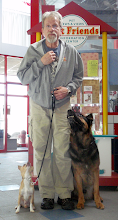
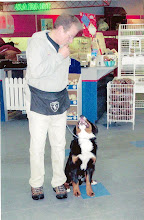
Look Ma' No hands! I just had Cinco G., a 10 month Golden Retriever, for only 2 training sessions over the weekend. It was really hard to keep his nose off the ground but with some practice he caught on quick. Here we are in the lobby of Best Friends Pet Care. I'm walking with the leash over my shoulder. He makes 2 about turns without a reminder tug, and sits automatically as I stop without saying, "sit".
I hope to see his family so I can show them how I work with Cinco. Hopefully after they practice they will sign him up for the group obedience class which is a great place to practice or perfect the skills with the distraction of other dogs.
There are three ways to get into my intermediate class. The easiest is Board and Train. I compare this to building a car. I build the car and when you pickup I'll teach you how to drive. I begin in quiet areas to bond and teach basic skills. We then perfect in stimulating areas which are abundant on our 6 acre facility.
The second is private lessons. Sometimes we can work together to train your dog. It is a little easier than group classes which have more distractions; which is a good thing when you and your dog are ready.
The last is to attend my 8 week Basic class. In the first classes you learn how to bond and guide your dog so by the end we are able to work all together as a class. If you need we can schedule a private along the way if you think it might help. If you have taken classes elsewhere give me a call or stop in and show me what you and your dog can do. Allan
Monday, August 16, 2010


Saturday, August 14, 2010
Jack F. practices the Recall
Jack is a 3 year old Golden Retriever . After some bonding in the Canine College where we practiced basic obedience. He is here for a week of Board and Train. The biggest problems were stay and coming when he is called. Hopefully we didn't teach him to run away or avoid coming to us due to an association with discipline of something he might not want to do. ie, "Come here to go into your crate or to cut your nails or to see the poop in the living room." Whatever the reason start with a leash. He must come and most important praise him when he comes with your voice, food, pet or throw a toy. Once he learns there is a positive reward he should come and avoid repeating the reasons he won't.
Here we are in the Canine College practicing. I have him "sit" and "stay" then return several times before I call him. This way he finds he just has to sit and I'll return to reward and he doesn't have to do anything. Then I try to stimulate to get him to come as fast as possible. We're just having fun hanging out with each other. You can tell he is enjoying this by how fast he comes. I also have to try in more stimulating areas.
Here we are in the lobby in a controlled area. I could use a long line or retractable to guarantee the desired result. He is enjoying the game and learning at the same time.
Thursday, August 5, 2010
Boomer K. and Allan do a pattern in the lobby
This is Boomer K. a big male Labrador Retriever about 4.5 years old in a week of board and train. I observed his Mom bring him to the hotel a week ago. I watched him drag her to the potty field and bully through the door. She was afraid he would bark aggressively towards other dogs.
I worked with his Dad, Chris, today and showed him how to patiently work on a Meet & Greet exercise and only let Boomer greet when he sits. It took a while when this overexcited dog saw his dad but patiently Boomer got to interact but the rule is that he must stay sitting and no touching with the mouth or feet. Then I showed Chris how to go through doors and get into Boomer's head just who is following whom. I then demonstrated to Chris how I do this obedience pattern. Finally it is Chris' turn to work with Boomer. I'm confident that with practice Boomer can work as well with Chris as you see Boomer work with me. He has some issues with other dogs but with us in the lead he can be good. The best place to practice is in an intermediate group class around other dogs. I would love to have a session with his Mom to prepare her to work with the group. I'll be there to help and guide them through the class. Hope to see you on Tuesday at 7 p.m. or Saturday at 10 a.m.

Tuesday, August 3, 2010
Bustin' some moves with Boomer K.
Without corrections how can you get your dog to pay better attention to the handler. Easy, bust some moves that require him to pay attention. Often in my group class the dogs are either going too fast or too wide and if the handlers are not vigilant the dog will have a larger space to assume is correct. Some dogs are so far out of what I would consider is the correct position caused by lenient handlers that the dog will either be too far in front to turn left without bumping his ribs or too far behind to stay on the left as you turn to the right.
Here we are in an isle. I start with a right 180° followed by a quick 180° or 360° to the left. As I do this the dog stays closer and in the correct position and has some fun as we are working together. I give him a job then tell him how well he is doing and he just loves to make the leader happy.
Now here we are in an even narrower isle. Again some right about turns followed by a quick left or even 2 German or Schutzhund about turns back to back. Instead of the dog moving with me and staying on my left I turn left and Boomer goes around to the right we end up making a circle with me in the middle going in opposite directions.
Saturday, July 10, 2010
New Puppy? Don't Wait To Start Training
Spring and summer are puppy season, when those cute, cuddly balls of fur arrive for the first time in many homes. While we all love puppies, those puppy behaviors - like jumping up and nipping - aren't so adorable coming from a 75 pound dog! That's why Best Friends professional trainers recommend beginning to train your puppy as soon as he arrives in your home.
Learning the basics
Every puppy needs to learn at least the four basic obedience commands: come, sit, stay, and down. Choose a time when your puppy is relaxed, and a quiet area with few distractions. Early training sessions should be short; it's better to spend a few minutes with a puppy several times a day than to try to sustain his interest for a single long period. Start with the "come" command, which is critical for your pet's safety. Best Friends trainers recommend using the leash method. Begin by putting a collar on your puppy. Once he's accustomed to wearing it, attach a leash and standing several feet away, say "come", and gently pull him towards you. As he reaches you, praise him, using a happy tone of voice. Gradually, your puppy will begin to associate the word with the action and you won't need to pull on the leash. Once that happens, practice the command without a leash. Remember to give him lots of praise when he responds by coming to you. Don't try to accomplish too much at once. End each session on a high note, just after your puppy has successfully performed a command. This will make the training process enjoyable and something to which puppy will look forward. As you see your puppy make progress with the first command, you can move onto to "sit" and then "stay". Once puppy has mastered these commands, you can begin to teach him to walk properly on a leash.
Getting started
There are many good books on puppy training, but best way to get your puppy's training started is by joining a group class. Training classes also provide an opportunity to socialize your pet, which is important to his emotional well-being. Dogs that aren't adequately socialized can become shy and fearful. In fact, many behavior problems in older dogs stem from lack of adequate socialization as a puppy. Check your local Best Friends center for class schedules.
Wednesday, June 30, 2010

Friday, June 18, 2010
Rally Obedience
This is the blog that coincides with the Rally Obedience Brochure for the free event on July 10, 2010. Please pre-register as there will be a limit of 5 to 15 dogs that will be able to try the course. Should there be too many entries we may add an additional day. There are generally 3 levels of Rally, Level 1 or Novice, Level 2 or Intermediate, and Level 3 is Advanced. Signs are usually to the handler's right or in front as they approach. There can be 15- 20 signs in a course.
Rally Level 1 or Novice

When the handler and dog get to this sign they should sit, then down then walk around their dog until back in the heel position then move forward to the next sign. Here is an example of Cathi doing the exercise with Lefty.
Here is the sign which leads the team to a serpentine weave.

Here is Cathi with Jazzy demonstrating how to do the serpentine weave. They should enter with the first cone on their left and then weave through the cones and go to the next sign.
Now is a sample of Level 2 or Advanced exercises.The first is a send over jump as the handler runs by. The handler must stay 6 feet to the side of the jump.

Here comes Sue sending Onslow over the jump.
The moves get a little more precise as we go on. Here is the sign for a pivot 180° to the left. The object is for the handler to do the exercise as though they are standing on a pie plate.

Now we have Cathi demonstrating this very cool exercise with Lefty. It starts with a sit and ends with a sit then off to the next sign in the new direction.
Now we have a couple of Level 3 or Excellent Rally Obedience moves. The first is the call to front over the jump then finish right or left by the handlers direction.

Now here comes Cathi with Jazzy doing a very nice exercise. Cathi will sit Jazzy then go to other side of the jump and then call her to the front then the finish is when the dog will either go to the right or the left and end up in the heel position next to the handler.
Here comes a moving stand. The dog stands without first sitting. The handler leaves and stands across from the dog. The dog is cued to down, then sit, then come and sit in front of the handler. Then the handler can choose to have the dog finish by going into the heel position to the left or the right as instructed.

Now watch Cathi do a very nice demo with her dog Lefty.
I'd like to give special thanks to Cathi and Sue who brought Jazzy, Lefty and Onslow to give me a hand with the Rally Obedience event and demonstration we'll be giving at 'Lambs Farm Woofstock' on June 19, 2010. You can view the Rally Course. We'll be on between 12 noon and 1 pm. Come and visit or if you like register for the free Rally Obedience clinic we'll be having here at Best Friends on July 10, 2010 at 9a.m. until 11:30 a.m.
Subscribe to:
Posts (Atom)

Pflash